
The military delegation will be in Delhi "shortly" and confer with top Indian Army officials as well as those in the ministry of external affairs to evolve a road map for a counter-insurgency strategy, reports Nitin Gokhale.
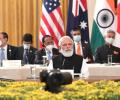
Prime Minister Narendra Damodardas Modi spent Friday in the company of United States President Joe Biden, first at their meeting in the Oval Office at the White House, then at the QUAD Summit.
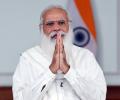
The main elements of the programme are bilateral meetings with the US leadership, participation in the Quad Leaders' Summit, address at the UN General Assembly and business interactions.

Home Minister Rajnath Singh on Saturday said India "sticks to its stand" that dialogue must be held only on terrorism at the Indo-Pak National SecurityAdvisor-level talks, which are under a cloud over the issue of Kashmiri separatists.
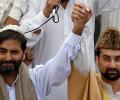
India on Friday made it clear to Pakistan that it should not go ahead with the meeting of its NSA Sartaz Aziz with Hurriyat representatives in New Delhi when he comes to hold talks with his Indian counterpart Ajit Doval, saying it will not be "appropriate".

The Biden administration has come under criticism from several quarters, including from members and supporters of the Democratic party, for not releasing surplus COVID-19 vaccines to India when the country is experiencing its worst-ever public health crisis.
The meetings with the chief ministers will be held on Saturday, an official said.
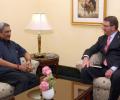
India and US on Wednesday night signed a new strategically important 10-year defence framework agreement setting the stage for co-development and manufacture of defence equipment.
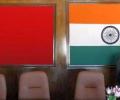
The Indian delegation at Thursday's talks is likely to be led by Naveen Srivastava, Joint Secretary (East Asia) in the external affairs ministry, they said.
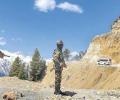
The meeting primarily focused on implementation of certain decisions taken at the fifth round of talks between Corps Commanders of the two armies last week on the disengagement process as well as to bring down prevailing tension in the region, sources said.
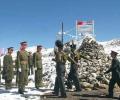
At the talks, the Indian side insisted on complete disengagement of Chinese troops at the earliest and immediate restoration of status quo ante in all areas of eastern Ladakh prior to May 5 when the standoff began following a clash between the two armies in Pangong Tso, they said.

'Modi's decision to hold out an olive branch to Sharif within 48 hours of the 'surgical strikes' has been a timely move as it helps tensions to 'de-escalate',' says Ambassador M K Bhadrakumar.

The next phase of the de-escalation process will kick off only after the fourth round of talks between corps commanders of the two sides.

India and China have so far held 19 rounds of talks to resolve the boundary dispute.

Shringla said that diplomacy is looking at a very changed scenario in terms of how statecraft and relations between countries work in the wake of the pandemic.
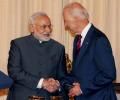
Biden and Modi committed that the US and India will work closely together to win the fight against the COVID-19 pandemic, renew their partnership on climate change, rebuild the global economy in a way that benefits the people of both countries, and stand together against the scourge of global terrorism, the White House said in a readout of the call.
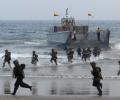
With an eye on beefing up maritime security, India is negotiating a deal with 24 countries for exchange of neutral merchant shipping data as it rolls out a national hub to tackle all aspects of coastal security to prevent another 26/11-like attack.
